DASC 2026 @ Orlando, Florida
Runtime Safety Filtering for Learned Small UAS Separation Policies under GNSS Degradation
Action filtering vs. observation filtering
Department of Mechanical and Aerospace Engineering · The George Washington University
- 3rd Best of Conference
- Best of Air Traffic Management Track
- Best of UAM/UAS Traffic Management and Separation Assurance Session
Where should a safety filter intervene?
Correct what the policy sees, or constrain what it does? Two runtime architectures share a worst-case state estimate, but produce very different safety outcomes.
- fewer near mid-air collisions
- 90%
- NMACs per episode
- 0.24 → 0.02
- average separation
- 250 → 375 m
Reported simulation comparison in the DASC presentation (slide 10); Rmax = 0.7 and α = 5 s. These are experimental results, not a general safety guarantee.
01 / The problem
A safe decision needs a trustworthy observation.
A decentralized separation policy uses nearby aircraft positions, velocities, and headings to select a speed change. GNSS multipath, blockage, or interference can distort those observations: an apparently clear path may conceal a closing conflict. The policy acts on the reported state, while safety is measured on the true state.
The controller
Three speed actions: slow down, hold speed, or speed up. Heading follows the structured route.
The safety measure
A near mid-air collision (NMAC) occurs when two aircraft pass within the 100 m separation threshold.
The uncertainty
Bounded adversarial observation degradation, with contamination rate R and a design bound Rmax selected before deployment.
02 / The comparison
Same estimate. Different decision authority.
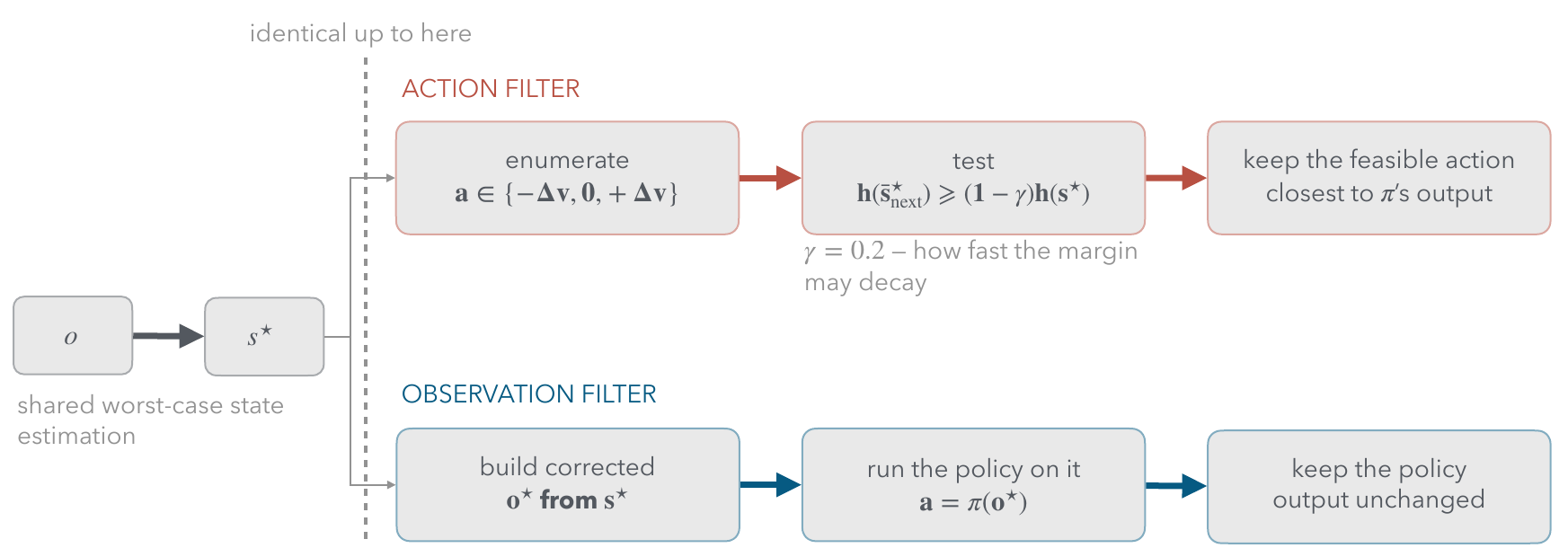
Both architectures estimate the worst-case traffic state under the assumed uncertainty bound. What changes is how that estimate interacts with the learned policy.
Action filtering
Enumerate candidate speed actions, test a discrete-time control barrier function condition, and keep the feasible action closest to the policy's proposal.
Observation filtering
Construct a corrected observation from the worst-case estimate, pass it to the policy, and retain the policy's chosen action.
03 / Experimental evidence
Correcting the input improves separation.
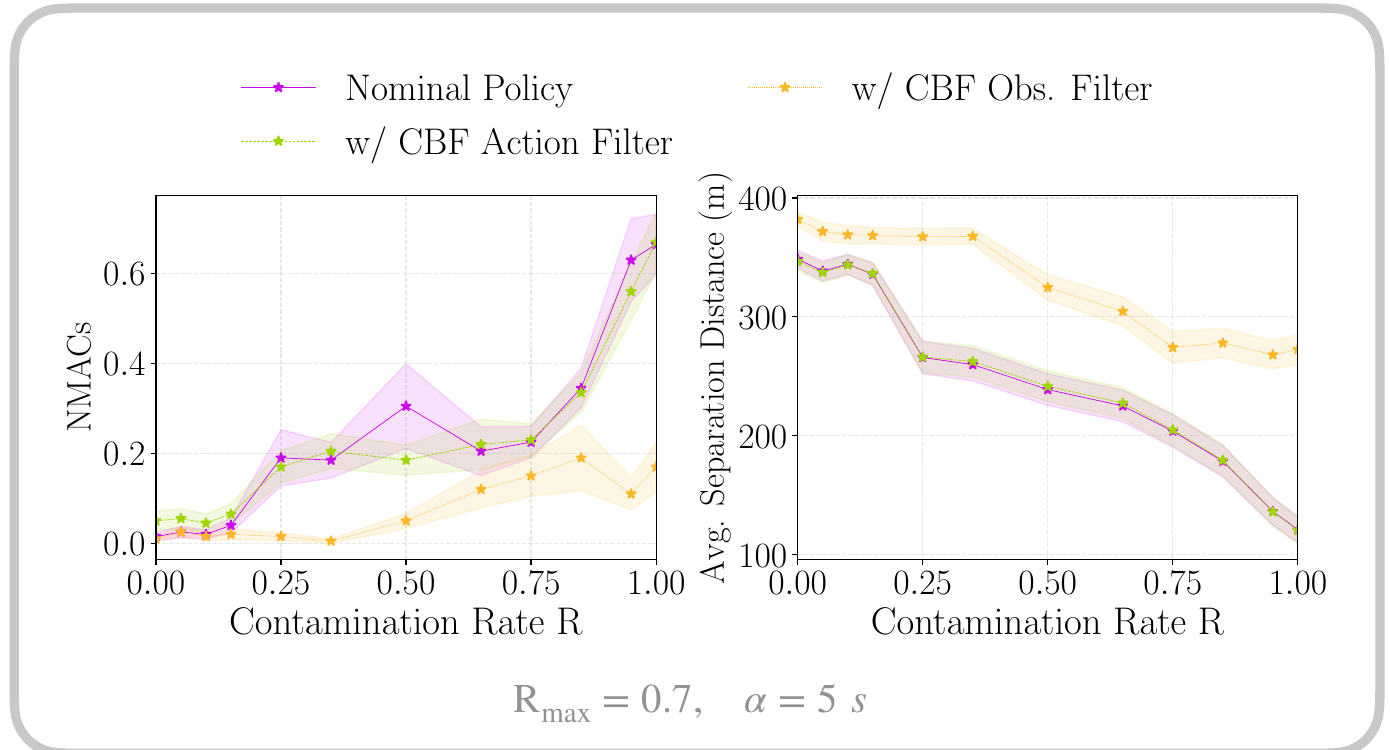
In the reported comparison, observation filtering reduces NMACs and increases average separation. Action filtering remains close to the unfiltered baseline. The curves below show how both measures vary as the actual contamination rate increases.
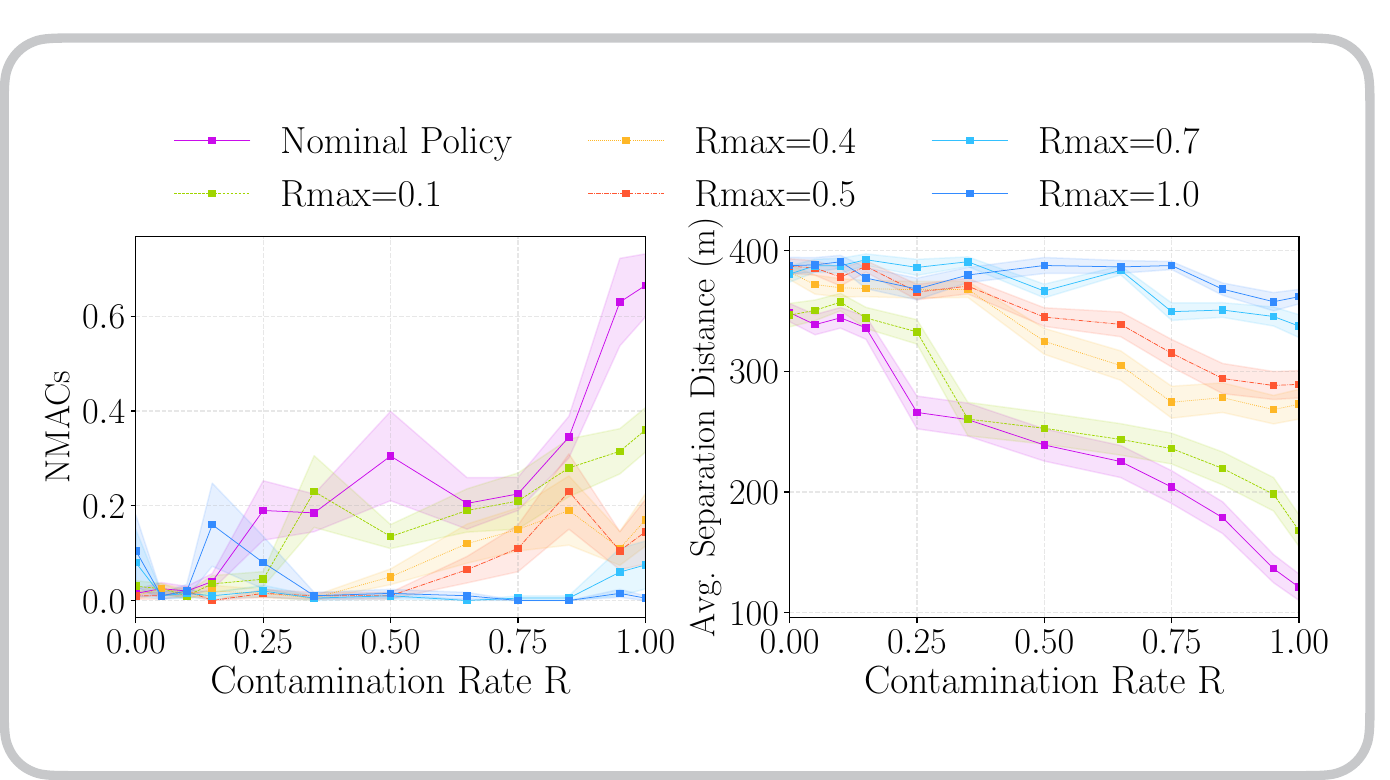
How much does the assumed degradation bound matter?
Smaller assumed bounds provide limited benefit. Larger bounds surface more conservative traffic states and improve separation in these experiments. The filter is not given the true contamination rate.
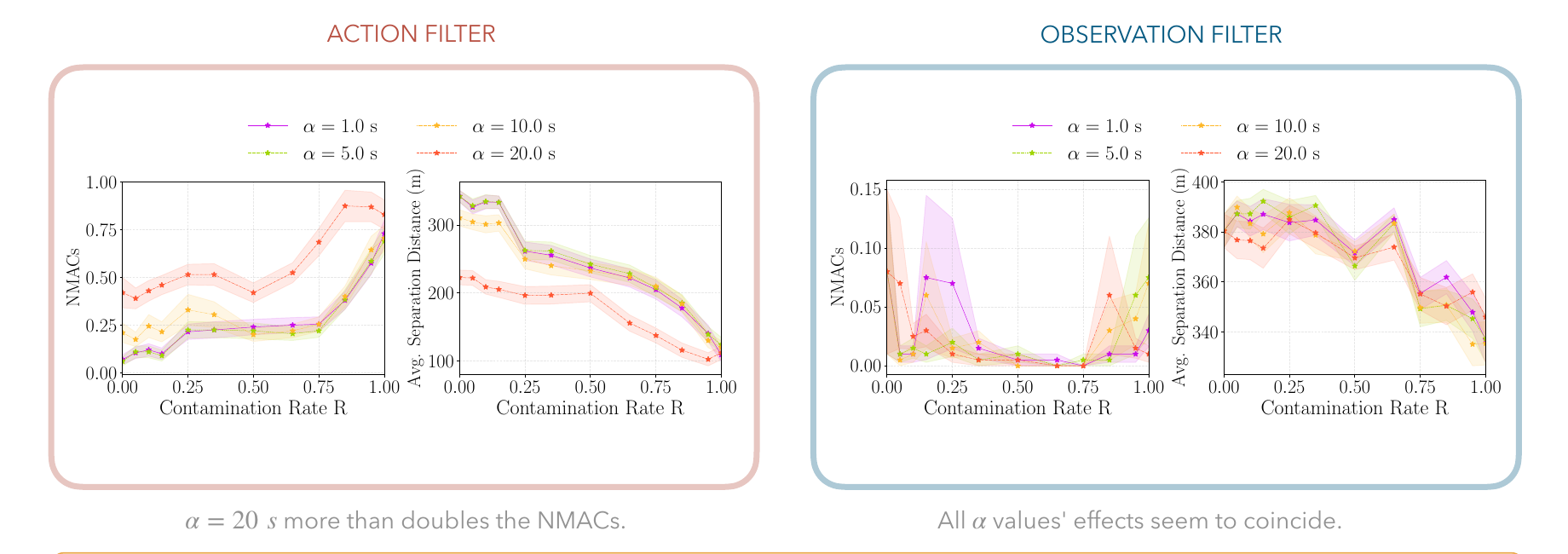
How sensitive are the filters to the barrier parameter?
Increasing α changes the balance between separation distance and closing rate in the barrier function. Action filtering is sensitive to that choice; the observation-filter curves remain comparatively similar.
04 / Interpretation & scope
Preserve the policy's learned safety behavior.
The presentation offers a possible explanation: the barrier tests a one-step condition, while the trained policy resolves encounters over multiple steps. Supplying a conservative observation lets the policy use that learned behavior. This is an interpretation of the observed results, rather than a universal ranking of safety-filter architectures.
A policy-dependent finding
The benefit depends on how the deployed policy was trained and the safety behavior it learned.
A cost in conservatism
A more cautious observation may trigger earlier or more frequent slowing down. Safety and efficiency must be assessed together.
Simulation scope
These results concern the evaluated learned policy, structured routes, and bounded GNSS-degradation model. They do not establish flight certification or hardware validation.
Reference
Cite this work
Zongo, A., & Wei, P. (2026). "Runtime Safety Filtering for Learned Small UAS Separation Policies under GNSS Degradation." arXiv:2607.10014. Accepted at DASC 2026.
@misc{zongo2026runtime,
  title = {Runtime Safety Filtering for Learned Small UAS Separation
           Policies under GNSS Degradation},
  author = {Alex Zongo and Peng Wei},
  year = {2026},
  eprint = {2607.10014},
  archivePrefix = {arXiv},
  primaryClass = {cs.RO},
  note = {Accepted at DASC 2026},
  url = {https://arxiv.org/abs/2607.10014}
}