IEEE CDC 2026 · to appear
Robust Multi-Agent Reinforcement Learning for Small UAS Separation Assurance under GPS Degradation and Spoofing
A closed-form adversary for decentralized separation policies
The George Washington University · The University of Texas at Austin, Oden Institute
What if the positions a policy sees are wrong?
In cooperative surveillance, every aircraft broadcasts its GPS-derived position. When those broadcasts are corrupted, the whole observed traffic picture becomes unreliable. We train separation policies that stay safe under a worst-case corruption that we can compute in closed form, without adversarial co-training.
- NMACs up to 35% corruption
- ≈ 0
- worst-case observation, no adversary training
- One shot
- accuracy of the closed-form worst case
- 2nd order
Simulation results averaged over 100 episodes in BlueSky with Amazon MK30 performance parameters, en-route package-delivery airspace. Not a flight-certified guarantee.
01 / The problem
Separation depends on a broadcast you cannot fully trust.
Each aircraft observes itself and up to five nearby intruders (position, speed, heading) within a 500 m detection radius, and a shared decentralized policy selects a speed change: slow down, hold, or speed up. GPS multipath, jamming, or spoofing corrupts those broadcasts, so the policy acts on a traffic picture that may not exist.
02 / Adversarial formulation
A two-player game over observations.
With probability \(R\), an adversary replaces the true traffic state \(\mathbf{S}\) with a corrupted observation \(\Xi\) inside a bounded uncertainty set \(\Omega(\mathbf{S}) = \{\Xi : \lvert\Xi - \mathbf{S}\rvert \le \kappa\}\), chosen to minimize the agents’ value. The policy must perform well under both the clean and the corrupted observation.
Robust value: the agents maximize return while the adversary corrupts the next observation with probability R.
03 / Closed-form adversary
The worst case, without training an adversary.
Instead of learning an adversary through iterative, unstable co-training, we derive the worst-case observation directly. A first-order expansion of the value function moves the corrupted state to the lowest-value corner of the uncertainty box. The expression is one-shot, linear-time in the state dimension, and approximates the true worst case with second-order accuracy.
The gradient is taken through a frozen teacher value function.
04 / Robust training
Stay invariant to corruption, stay close to nominal.
Two regularizers shape the robust policy. An invariance term penalizes \(\mathrm{KL}\big(\pi(\cdot\mid\mathbf{S})\,\Vert\,\pi(\cdot\mid\Xi^{\star})\big)\), so the decision is the same whether the observation is clean or corrupted. An anchor term keeps the robust policy close to a nominal teacher, so robustness is not bought by giving up clean performance. If the invariance gap is bounded by \(B\), the performance loss under corruption is bounded by \(Q_{\max}\sqrt{2B}\); a smaller \(B\) means a tighter guarantee.
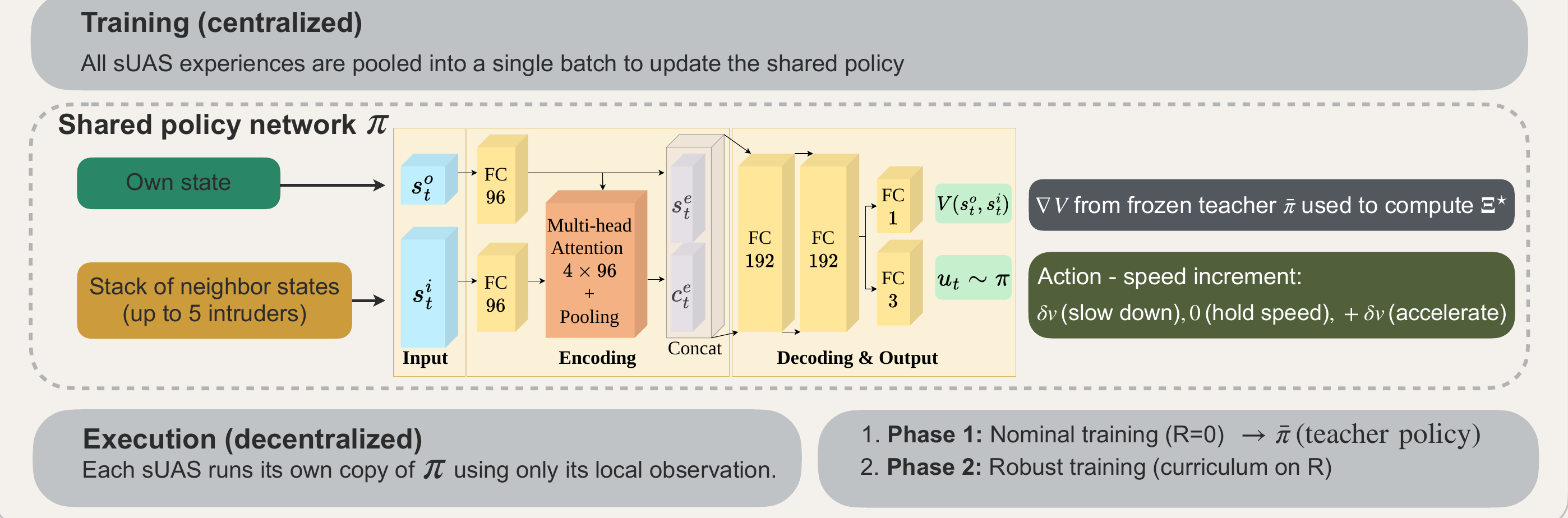
Phase 1: nominal
Train a teacher policy with no corruption (R = 0).
Phase 2: robust
Fine-tune with the closed-form adversary and a curriculum on R.
Execution
Centralized training, decentralized execution: each aircraft runs its own copy using only local observations.
Policy architecture
A shared network encodes the ownship state and a stack of up to five neighbor states with multi-head attention and pooling, then decodes a value estimate and a speed-increment action.
05 / Results
Graceful degradation as corruption grows.
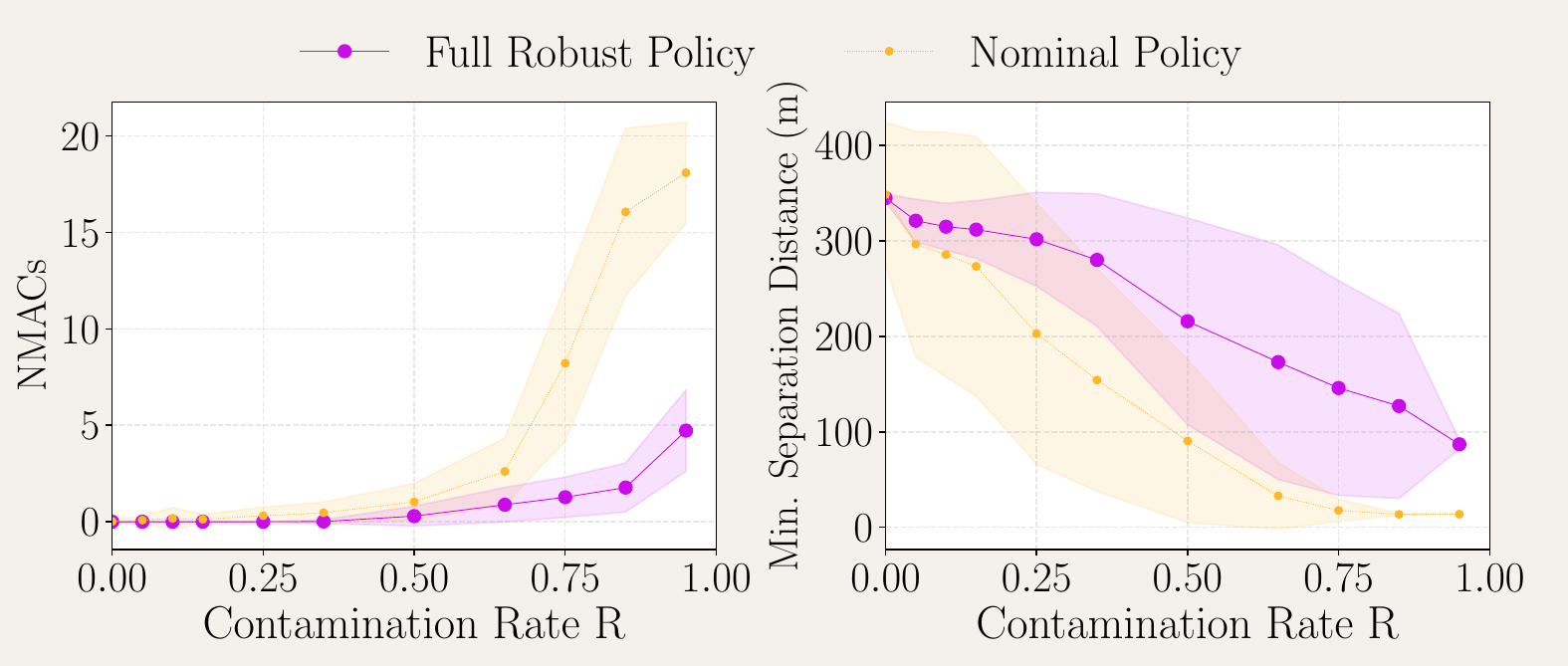
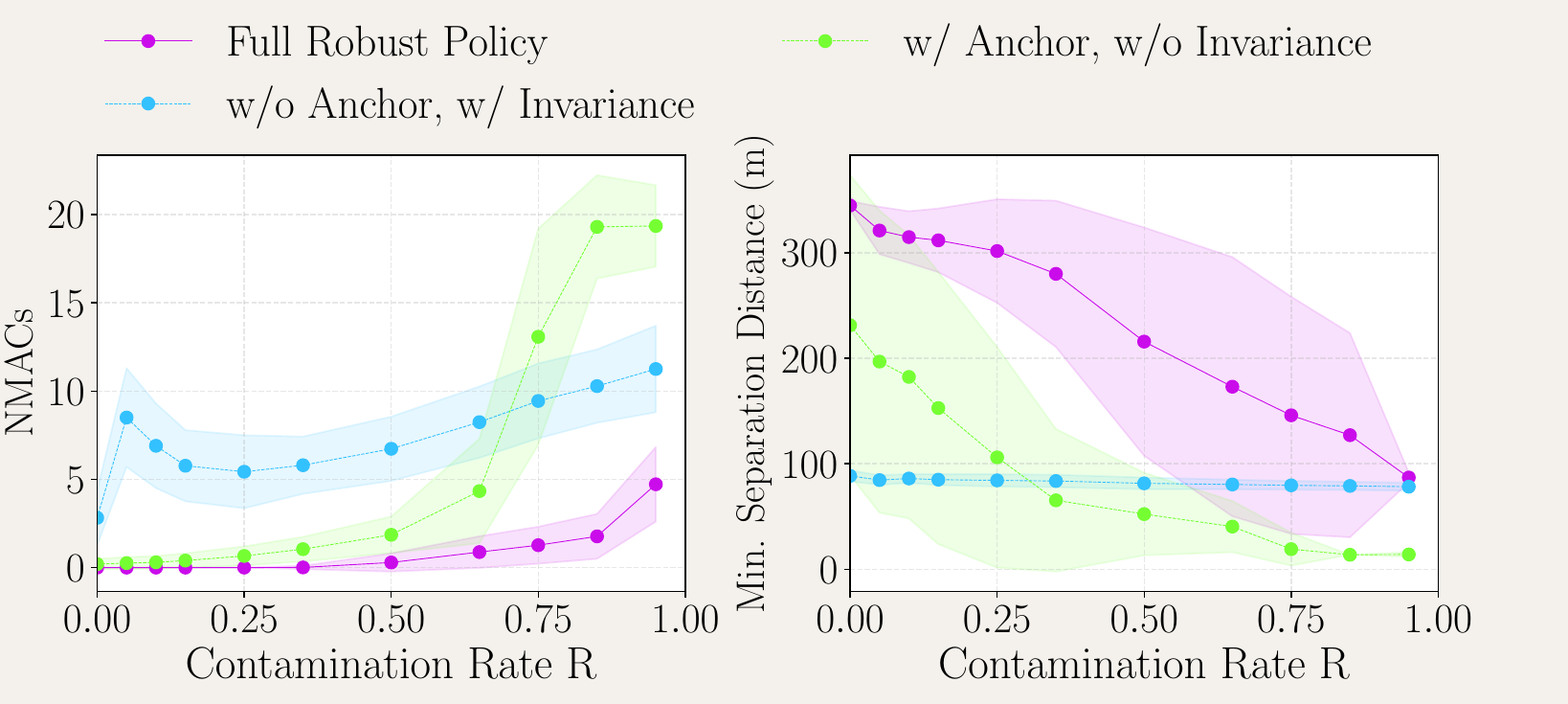
The robust policy keeps near mid-air collisions (NMACs) near zero up to a 35% contamination rate and degrades gracefully beyond it, while the nominal policy deteriorates sharply. Ablations show that both regularizers are needed: invariance alone destabilizes training, and anchoring alone preserves nominal behavior but collapses at high corruption.
Simulation environment
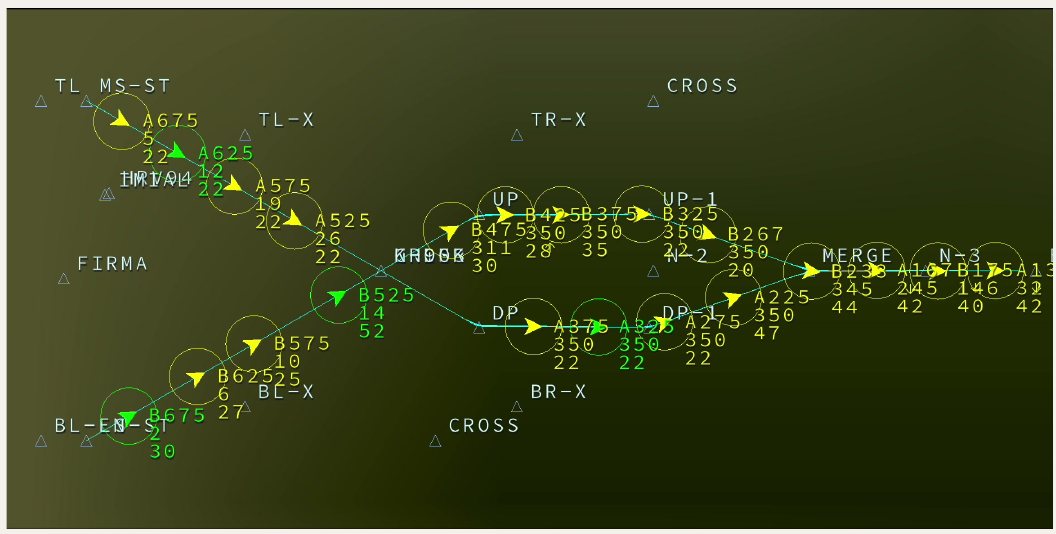
BlueSky air traffic simulator with Amazon MK30 performance parameters, en-route package-delivery airspace.
06 / Scope and next steps
Where this applies, and what comes next.
The approach applies to any cooperative multi-agent system whose shared observations can be corrupted. The evidence here is simulation-based. Follow-up work places a runtime safety filter around the deployed policy (DASC 2026); code will be released with the redesigned environment.
Reference
Cite this work
Zongo, A., Fotiadis, F., Topcu, U., & Wei, P. (2026). "Robust Multi-Agent Reinforcement Learning for Small UAS Separation Assurance under GPS Degradation and Spoofing." arXiv preprint arXiv:2603.28900.
@misc{zongo2026robust,
  title         = {Robust Multi-Agent Reinforcement Learning for Small UAS Separation
                   Assurance under GPS Degradation and Spoofing},
  author        = {Alex Zongo and Filippos Fotiadis and Ufuk Topcu and Peng Wei},
  year          = {2026},
  eprint        = {2603.28900},
  archivePrefix = {arXiv}
}
Acknowledgement. This work was supported by NASA under grant 80NSSC24M0070 and by ONR under grant N00014-22-1-2703.