Accepted · OCEANS 2026 IEEE
Large Language Model Guided Reinforcement Learning for Maritime Ship Collision Avoidance
COLREGs reasoning meets learned vessel control
Mechanical and Aerospace Engineering · Computer Science · The George Washington University
From navigation rules to maneuver decisions.
Language-based maneuver intent guides a learned controller, with supervisory arbitration connecting the two.
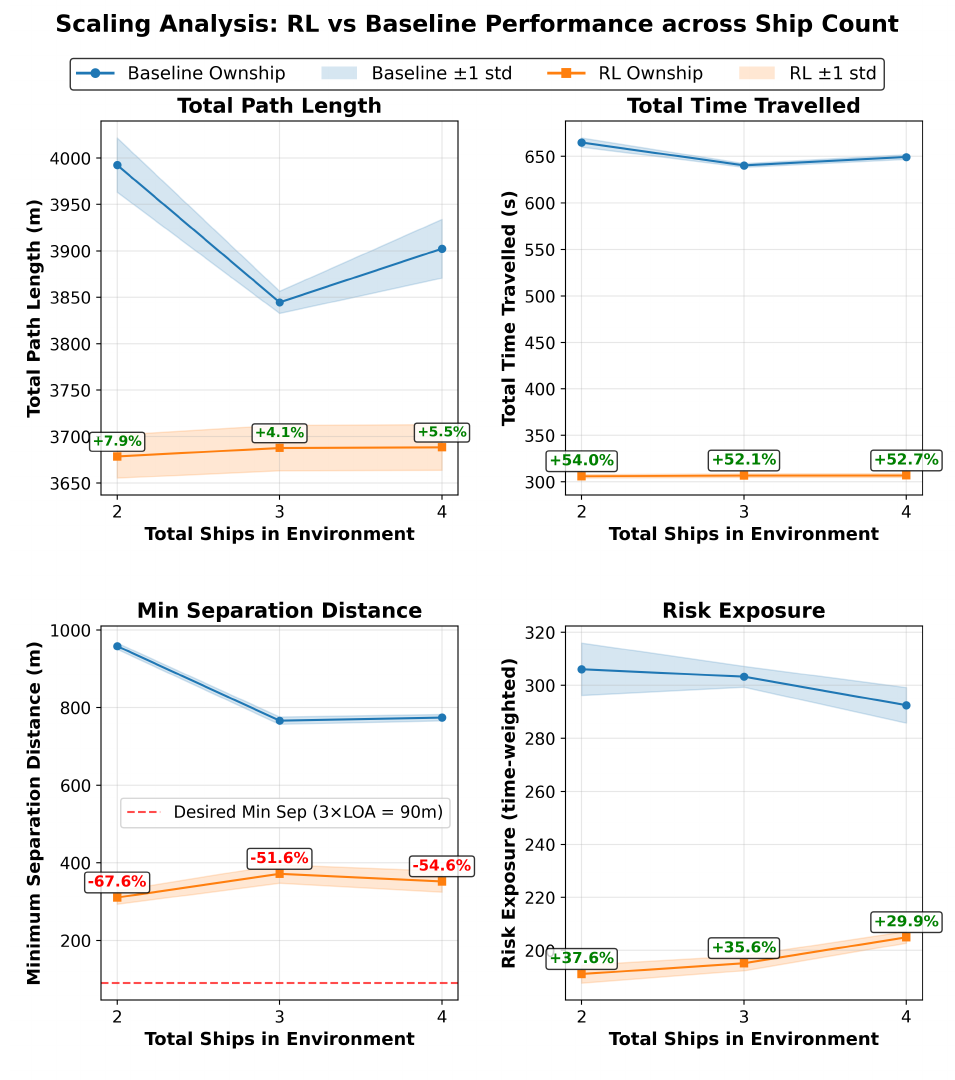
- less route-completion time
- Up to 54%
- less cumulative risk exposure
- Up to 37%
- collision-free completed episodes
- 300 / 300
Time and risk compare the learned and rule-based planners. Episode completion comes from a separate full-pipeline evaluation; neither establishes a general safety guarantee.
01 / Architecture
Separate intent from execution.
Interpret
An LLM supplies COLREGs-based maneuver intent.
Control
PPO proposes heading and speed actions.
Arbitrate
A supervisor combines guidance and control, retaining fallback authority.
02 / Planner comparison
Efficiency gains, with tighter separation.
The learned planner improves time and risk metrics, but maintains smaller minimum separation than the baseline.
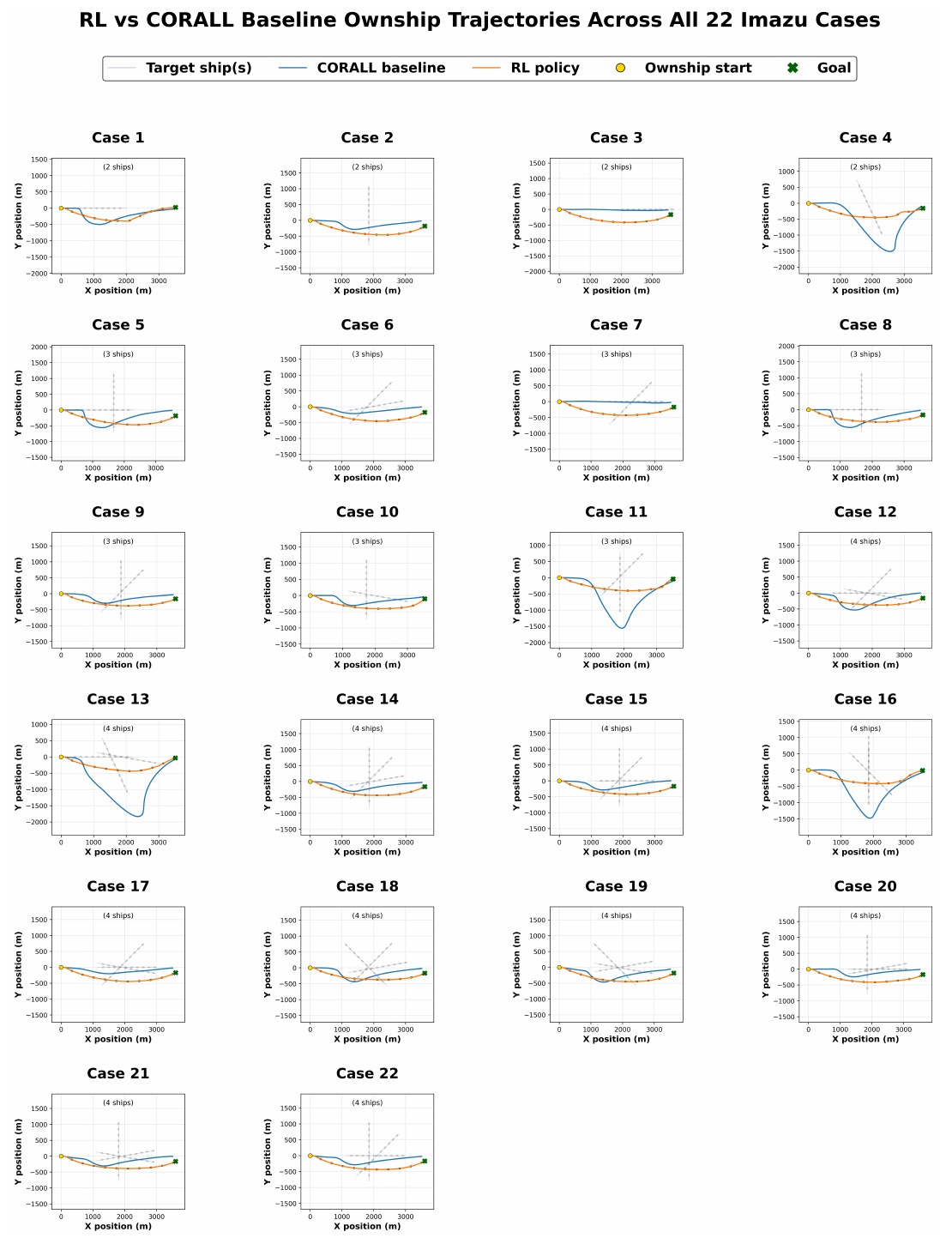
Inspect all 22 encounter trajectories
Ownship trajectories are compared against scripted target vessels.
03 / Full-pipeline evaluation
Fallback control matters.
| Case | Usable intent | Strict accuracy | Episode success |
|---|---|---|---|
| 1 | 64.9% | 100.0% | 100.0% |
| 6 | 79.5% | 91.9% | 100.0% |
| 18 | 73.6% | 96.6% | 100.0% |
| Overall | 72.7% | 96.0% | 100.0% |
9,507 LLM calls; strict accuracy uses the high-confidence, single-label subset. Success uses 100 episodes per case.
04 / Limits
Simulation evidence, not deployment certification.
One controlled ownship encounters scripted traffic. Broader geometries, more reliable guidance, and multi-agent control remain future work.
Reference
Cite this work
Pang, Y., Aziz, A., Zongo, A., Wei, P., and Crandall, K. (2026). "Large Language Model Guided Reinforcement Learning for Maritime Ship Collision Avoidance" OCEANS 2026 IEEE, Monterey, CA, USA.
@misc{pang2026maritime,
  title = {Large Language Model Guided Reinforcement Learning for Maritime Ship Collision Avoidance},
  author = {Pang, Yasmin and Aziz, Arsyi and Zongo, Alex and Wei, Peng and Crandall, Kyle},
  year = {2026},
  note = {Preprint; accepted for OCEANS 2026 IEEE},
  url = {https://bpb-us-w2.wpmucdn.com/web.seas.gwu.edu/dist/9/15/files/2026/09/Yasmin_LLM_Guided_RL_COLAV_OCEANS_2026.pdf}
}