Manuscript in preparation · 2026
Aircraft Trajectory Prediction under ATC Instruction Uncertainty
Predicting aircraft motion from ADS-B and imperfectly recognized controller speech
UC Berkeley (CITRIS) · The George Washington University
Where will the aircraft go, given what the controller said?
A controller instruction changes an aircraft's next minute of flight before any sensor sees it. Speech recognizers mishear callsigns, numbers and turn directions, so we treat each controller transmission as uncertain evidence: infer what it could mean, then predict the trajectory under each interpretation.
- lower energy score than history-only prediction on maneuver instructions to the aircraft
- 47%
- from the oracle that is given the ground-truth interpretation
- 126 m
- of recorded transmissions: addressed aircraft ranked first among about 12
- 98%
Synthetic test set: 5,000 trajectory segments, means over three training runs; energy score over 60 s, in metres. Recorded speech: 338 controller transmissions from a public radio feed matched to ADS-B, a private evaluation set.
01 / The problem
Instructions arrive as noisy speech.
Trajectory predictors used in air traffic management extrapolate from surveillance history. They cannot anticipate a turn or a descent that a controller has just issued, because the aircraft has not started it yet. The instruction is on the radio, but a machine only receives it through automatic speech recognition (ASR), which drops and confuses words. Every aircraft on the frequency also hears every transmission, and most transmissions are addressed to someone else.
What is uncertain
Whether the transmission is addressed to this aircraft, and which heading, altitude or speed it instructs. A misheard callsign, a lost “left” or “right”, or a wrong digit each changes the trajectory.
What is available
The ASR transcript with each word's confidence, the aircraft's own callsign and its last 30 s of ADS-B.
What is predicted
A distribution over the next 60 s of flight, evaluated against the flown trajectory with the energy score (a proper scoring rule for distributions, in metres, lower is better) and the coverage of its prediction intervals.
02 / The approach
Interpret first, then predict under each interpretation.
An interpretation Z is a structured reading of a transmission: whether it is addressed to this aircraft, and which lateral, vertical and speed instruction it contains. A semantic belief model reads the transcript, the word confidences, the aircraft’s callsign and its history, and returns a distribution over interpretations. A conditional trajectory predictor, a rectified flow on 18 trajectory-shape coefficients, generates future trajectories under a given interpretation. The composed prediction mixes the two: 12 interpretations drawn from the belief, 6 trajectories under each.
Y: future trajectory. O: received transcript with word confidences. X: surveillance history and callsign. Z: interpretation of the transmission.
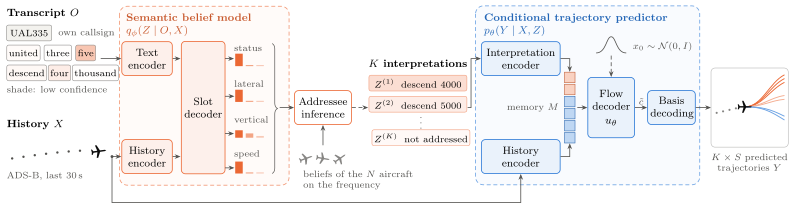
Why an explicit interpretation instead of conditioning on the text?
A trajectory model conditioned directly on the transcript reaches an energy score of 2,187 m on maneuver instructions to the aircraft, against 1,682 m for composition through interpretations. The interpretation is also readable: a controller or an engineer can check what the model believed the transmission said.
Why a flow on trajectory-shape coefficients?
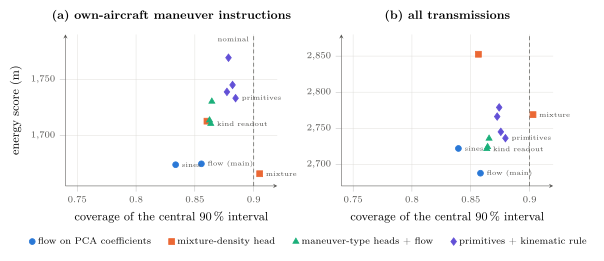
We compared four designs for the conditional trajectory predictor, trading accuracy (energy score) against calibration (how often the flown trajectory falls inside the central 90% interval). The rectified flow on principal-component coefficients of trajectory shape gives the lowest energy score over all transmissions and is among the most accurate on maneuver instructions. A mixture-density head can reach the nominal coverage, but its accuracy varies widely between configurations, especially over all transmissions. Most designs stay somewhat below 90% coverage, so the predictions are mildly overconfident.
Which aircraft is the transmission addressed to?
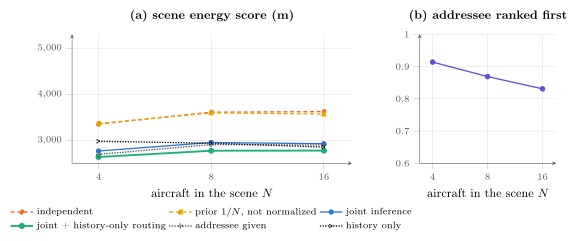
Each aircraft's belief includes the probability that it is addressed. On a frequency, a transmission addresses at most one aircraft, so we remove the training prior from each aircraft's evidence and normalize across the aircraft present. With eight aircraft in constructed scenes, the addressed aircraft is ranked first for 87% of transmissions.
03 / Synthetic test set
Composing interpretations beats committing to one.
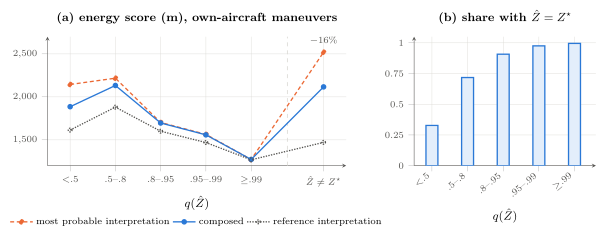
On 5,000 test trajectory segments with simulated ASR errors, the composed prediction closes most of the gap between history-only prediction and an oracle given the ground-truth interpretation, the one each synthetic transmission was generated from. It also beats conditioning on the single most probable interpretation in every training run.
| Prediction | Maneuver instructions to the aircraft | All transmissions |
|---|---|---|
| History only (ignores the radio) | 3,202 | 2,988 |
| Trajectory model conditioned on the transcript | 2,187 | 2,751 |
| Most probable interpretation | 1,727 ± 2 | 2,732 |
| Composed over interpretations | 1,682 ± 5 | 2,701 |
| Oracle: ground-truth interpretation given | 1,556 ± 2 | 2,615 |
History only remains better on transmissions that instruct no maneuver or address another aircraft (2,988 against 3,152 to 3,296 m), which is where the remaining error is.
04 / Recorded controller speech
The interface transfers to real radio.
We transcribed 72.9 h of a public departure-control radio feed over the San Francisco Bay Area with a general-purpose recognizer and matched controller transmissions to ADS-B by callsign. On 338 transmissions with sufficient surveillance coverage, composition improves on history-only prediction by 9%, and the addressed aircraft is ranked first among about 12 nearby aircraft for 98% of transmissions. Frequency changes are read as transmissions that instruct no maneuver 87% of the time.
The limits are clear as well. The prediction is overconfident on recorded speech, the vertical score does not beat history alone, and part of the training phrasing was taken from the same radio feed, so this evaluation is not fully independent. The recordings and transcripts are not redistributed.
05 / Scope
What this does not do.
Interpretations
Heading, altitude and speed instructions. Route, conditional and procedure clearances are outside the interpretation space.
Training data
Synthetic controller transmissions generated on real ADS-B tracks from five days in the Bay Area, passed through a simulated ASR channel. Real phraseology is broader.
Use
A research prototype for prediction under communication uncertainty, not an operational tool.
Reference
Cite this work
Zongo, A., Petit, M., Brusset, L., Kam, J., Torun, E., Ghazanfari, M., Wei, P., and Bayen, A. (2026). "Aircraft Trajectory Prediction under ATC Instruction Uncertainty." Software; paper in preparation.
@software{zongo2026atc,
  author = {Zongo, Alex and Petit, Mathurin and Brusset, Louis and Kam, Jordan and
            Torun, Emir and Ghazanfari, Mahyar and Wei, Peng and Bayen, Alexandre},
  title  = {Aircraft Trajectory Prediction under {ATC} Instruction Uncertainty},
  year   = {2026},
  url    = {https://github.com/Alex-Zongo/atc-trajectory-prediction},
  note   = {Software; paper in preparation}
}
Acknowledgement. This work was carried out within a CITRIS project at UC Berkeley. Aircraft surveillance data comes from the OpenSky Network.